At Prairie Hill Waldorf School, we often hear the misconception that Waldorf education prioritizes the arts at the expense of the “hard” sciences. If you stepped into our gym this past week for the Middle School Science Exploratorium, you saw firsthand that the truth is far more vibrant.
In a Waldorf classroom, science isn’t just a series of formulas to memorize from a textbook; it is a journey of observation, curiosity, and human connection. Our educators utilize a phenomenological approach, where students first encounter a phenomenon, observe it deeply, and only then begin to characterize the laws at work.
Where Art and Hypothesis Meet
This year’s projects showcased the incredible breadth of our students’ curiosity. From the invisible forces of magnetism to the biology of nutrition and the chemistry of fermentation, the Exploratorium was a testament to what happens when students are given the freedom to ask “Why?”
One project, titled “How Copper Reacts to Magnets,” explored the fascinating world of electromagnetism. To understand these complex forces, students look at the history of the discovery and the pioneers who paved the way.
By studying the concepts of Lenz’s Law—where an induced electric current flows in a direction such that the current opposes the change that induced it—students see that science isn’t just about what happens, but the beautiful, logical “everything” of how the universe hangs together.
Science with a Human Face
Unique to the Waldorf approach is the integration of biography. Our students don’t just study a reaction; they study the human being who discovered it.
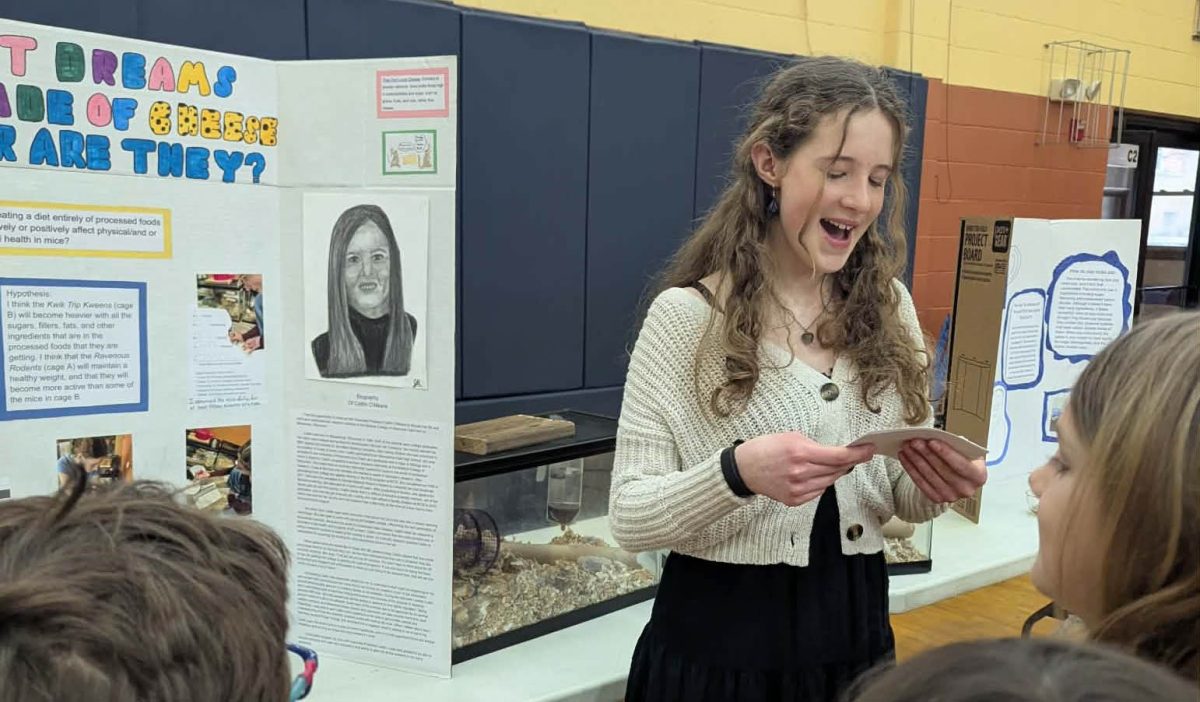
On one display board, alongside a rigorous experiment titled “Sweet Dreams are Made of Cheese, or Are They?” (an investigation into the effects of processed foods), sat a beautifully hand-rendered charcoal portrait of Associate Professor Caitlin O’Meara. By interviewing and researching contemporary scientists, our students bridge the gap between classroom theory and real-world cardiovascular research. They see themselves in the scientists they study.
From Fruit to Fermentation
Across the room, another student stood proudly by his investigation: “What Fruit Produces the Most Alcohol?” This project delved deep into the life cycle of yeast and the chemical process of fermentation.
Through this experiment, the student didn’t just learn about sugar conversion; he practiced the discipline of a scientist—straining fruit, measuring gravity with a hydrometer, and meticulously recording the stages of first and second fermentation.
The Waldorf Difference
The Science Exploratorium is about more than just data points. It is about developing the powers of observation. When a student spends weeks watching a mouse’s behavior or waiting for a fermentation bubble, they are developing a patience and an analytical eye that will serve them in any field they choose to enter.
We are so proud of our Middle Schoolers for their hard work, their artistic presentations, and their willingness to dive headfirst into the mysteries of the natural world. They have proven once again that when you bring math and science to life through experience, the results are nothing short of “Everything.”